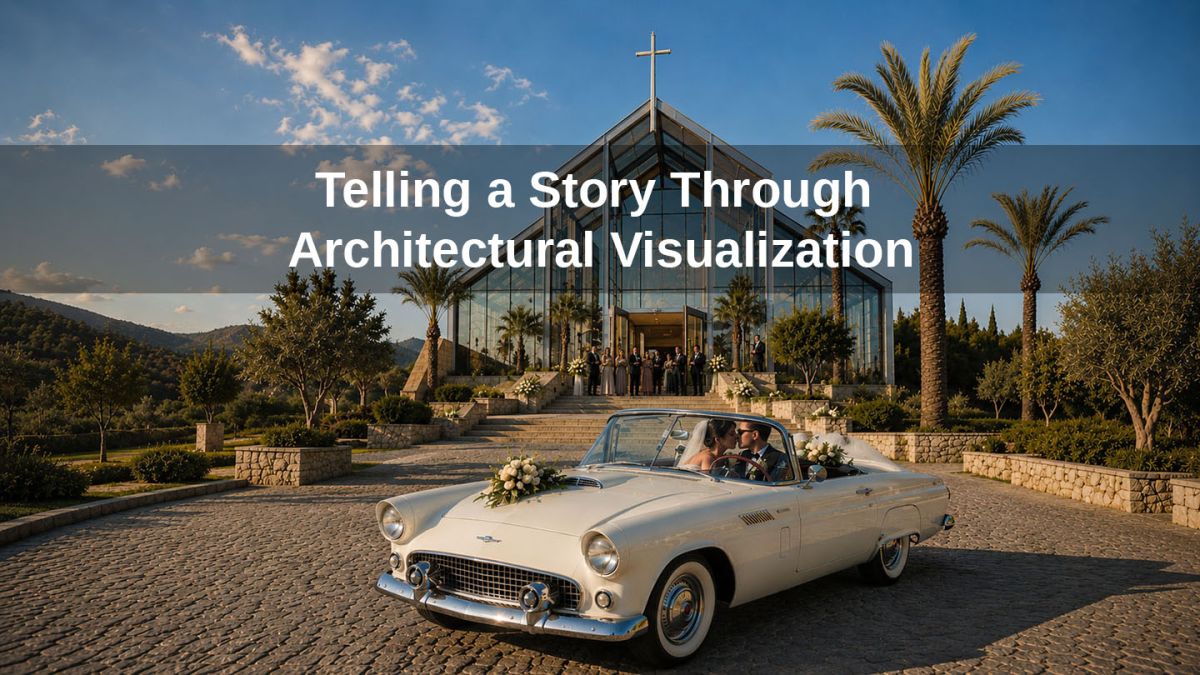
Telling a Story Through Design
How Images Communicate Emotion, Narrative, and Human Experience
At 3DAStudio™, one of the core principles behind what we call Cinematic ArchViz™ is the belief that architectural visualization should do more than simply depict what a building will look like when completed. The strongest architectural images tell a story. They communicate atmosphere, emotion, lifestyle, memory, aspiration, and human experience through light, composition, environment, and narrative detail.
A technically accurate rendering may explain a project, but a storytelling image makes people feel something about it.
This is where architectural visualization begins to overlap with cinematography, photography, painting, and visual storytelling. The image stops becoming merely documentation and starts becoming an emotional experience — a moment inside a possible future.
The most memorable architectural imagery often leaves viewers asking questions:
- Who lives here?
- What kind of life unfolds in this place?
- What just happened?
- What is about to happen?
- What does it feel like to stand there?
Those questions are what transform architectural visualization from illustration into narrative art.
Storytelling Existed Long Before Architectural Rendering
Long before CGI existed, painters mastered visual storytelling.
Many of the greatest works of art in history are memorable not because of technical perfection, but because they communicate narrative and emotional tension through composition, lighting, gesture, atmosphere, and implied human experience.
Examples include:
- Nighthawks
- The Fighting Temeraire
- The Last Supper
- Christina's World
- Guernica
- American Gothic
- The Scream
Each of these works tells a story through atmosphere, composition, emotional tension, symbolism, lighting, or implied narrative. The viewer senses that something larger exists beyond the frame.
Architectural visualization operates in much the same way.
Architectural Visualization Is Environmental Storytelling
Architecture is unique because it tells stories through environments rather than individual subjects.
An architectural image can communicate:
- wealth
- comfort
- loneliness
- ambition
- nostalgia
- decay
- hope
- community
- exclusivity
- serenity
- tension
- luxury
- resilience
- escape
- urban pressure
- human connection
The architecture itself matters, but the emotional context surrounding the architecture often matters more.
A modern home overlooking a foggy coastline tells a different story than the same house rendered on a bright summer afternoon. A quiet library interior lit by soft morning light communicates something entirely different than a bustling corporate lobby at night.
The image becomes emotional architecture rather than technical documentation.
The Most Important Question
Before beginning a rendering, the visualizer should ask:
“What is the story of this image?”
Not:
- What rendering engine should I use?
- What LUT should I apply?
- What material library looks best?
Those are technical questions.
Storytelling begins with emotional intent.
Examples:
- A rainy urban apartment tower may communicate solitude and introspection.
- A mountain retreat may suggest refuge, warmth, and family connection.
- A corporate campus may communicate ambition, innovation, and status.
- A waterfront home at dusk may imply aspiration and emotional escape.
Once the emotional direction is established, every artistic decision becomes easier.
Human Presence Creates Narrative
One of the strongest storytelling tools in architectural visualization is subtle human presence.
A completely empty rendering often feels emotionally sterile unless emptiness itself is part of the narrative.
People provide:
- scale
- relatability
- emotional context
- movement
- narrative clues
- implied activity
The key is restraint and believability.
Weak storytelling often includes:
- random stock people
- perfectly posed figures
- people staring at the camera
- overcrowded scenes
Strong storytelling often includes:
- a child chasing pigeons
- someone reading quietly near a window
- a couple talking softly on a balcony
- workers leaving an office in the rain
- a parent helping a child into a car
- someone waiting alone under an overhang during a storm
These moments imply life without overpowering the architecture.
The goal is not to decorate the image with people. The goal is to suggest human existence.
Lighting Is Emotional Language
Lighting may be the single most powerful storytelling tool in visualization.
Different lighting conditions communicate entirely different emotional narratives.
Overcast light can suggest:
- melancholy
- realism
- calmness
- introspection
- Pacific Northwest atmosphere
Golden hour can suggest:
- warmth
- aspiration
- romance
- comfort
- prestige
Blue hour can suggest:
- sophistication
- cinematic atmosphere
- luxury
- emotional depth
Harsh midday light can suggest:
- realism
- honesty
- heat
- exposure
- energy
Lighting is not simply illumination.
Lighting shapes emotional interpretation.
This is why many great paintings and films are remembered for their lighting as much as their subjects.
Atmosphere and Weather Add Emotional Depth
Fog, haze, rain, snow, humidity, smoke, and atmospheric perspective create mood while adding realism and depth.
A perfectly clear image often feels artificial because reality rarely appears clinically perfect.
Subtle atmosphere:
- softens distant objects
- creates depth layering
- reduces overly sharp CGI appearance
- introduces realism
- establishes emotional tone
This is one reason Scandinavian-inspired architectural imagery often feels emotionally compelling. It embraces atmosphere rather than fighting it.
A rainy street with warm interior lights often feels more emotionally believable than a perfectly sunny day.
Imperfection Makes Images Feel Alive
Real environments contain:
- wear
- asymmetry
- irregularity
- clutter
- movement
- unpredictability
- weathering
Overly perfect images often feel synthetic.
Storytelling improves when environments show evidence of life already occurring within them.
Examples include:
- slightly messy furniture
- wet pavement
- footprints in snow
- a bicycle leaning against a wall
- leaves gathered near a curb
- subtle material weathering
- uneven landscaping
- softly disturbed fabric
- dishes left on a table
These details imply human occupation and lived experience.
The environment begins to feel inhabited rather than staged.
Composition Directs the Viewer Emotionally
The viewer’s eye should move intentionally through the image.
Painters, photographers, and cinematographers use:
- leading lines
- framing
- contrast
- silhouette
- layering
- negative space
- focal isolation
Architecture itself often provides these naturally.
Questions to ask:
- What is the focal point?
- Where does the eye go first?
- What emotional rhythm exists within the composition?
- Is the composition calm or tense?
- Does the image invite exploration or confrontation?
Good storytelling composition guides the viewer emotionally through the frame.
Implied Motion Creates Energy
One of the biggest weaknesses in many architectural renderings is that they feel frozen.
The image may be technically excellent but emotionally static.
Motion can be implied through:
- blowing trees
- moving clouds
- rain streaks
- fabric reacting to wind
- reflections in water
- people mid-action
- vehicles entering or leaving
- shifting light
- birds in motion
Even subtle movement cues create life.
This is particularly important today because many AI-generated images feel posed and emotionally lifeless unless movement is intentionally introduced.
Motion creates implied time.
Implied time creates narrative.
Time of Day Changes the Story
The same building can communicate completely different emotions depending on time of day.
Morning may suggest:
- beginnings
- optimism
- calmness
- renewal
Afternoon may suggest:
- realism
- productivity
- clarity
- activity
Dusk may suggest:
- emotional transition
- atmosphere
- intimacy
- luxury
Night may suggest:
- mystery
- exclusivity
- loneliness
- drama
Architectural storytelling often depends as much on timing as on the architecture itself.
Context Is Part of the Narrative
Architecture rarely exists in isolation.
The surrounding environment contributes heavily to storytelling:
- geography
- weather
- vegetation
- infrastructure
- density
- cultural cues
- neighboring buildings
- terrain
- season
A mountain retreat in Norway tells a different story than a similar structure in Arizona.
A dense Tokyo alley communicates something different than an open Pacific Northwest waterfront.
Context creates authenticity.
Emotional Contrast Creates Tension
Some of the strongest storytelling images rely on contrast:
- warm interiors against cold rain
- modern architecture against rugged nature
- stillness within density
- light against darkness
- solitude within crowds
Contrast creates emotional tension.
Tension creates narrative interest.
Without some level of emotional contrast, images often feel flat.
Storytelling Matters Commercially
Storytelling is not merely artistic.
It is commercially powerful.
Developers and architects often believe they are selling buildings.
In reality, they are selling:
- identity
- aspiration
- lifestyle
- emotional experience
- belonging
- prestige
- comfort
- possibility
People rarely buy square footage emotionally.
They buy imagined future experiences.
This is why emotionally resonant imagery often outperforms technically perfect but emotionally empty renderings.
Architectural Visualization Is Closer to Filmmaking Than Drafting
At its highest level, architectural visualization becomes a form of cinematic environmental storytelling.
The visualizer becomes:
- director
- cinematographer
- lighting designer
- photographer
- production designer
- storyteller
The rendering stops being:
“A picture of a building.”
Instead, it becomes:
“A moment inside a possible future.”
That is what makes people remember it.
Cinematic ArchViz™ and the Art of Storytelling
At 3DAStudio™, we believe some of the most memorable architectural images are the ones that go beyond simply presenting architecture and instead create atmosphere, emotion, and narrative. We try to make each image feel special — not just technically accurate, but emotionally engaging and visually memorable.
This philosophy is one of the foundational ideas behind what we call Cinematic ArchViz™.
For us, architectural visualization is not only about showing a structure. It is about communicating the experience of being there. The lighting, weather, composition, movement, environmental context, and human moments within the frame all work together to help tell a story.
The goal is not simply to render a building.
The goal is to create an image people remember.
Related Articles in This Series
Architectural visualization is more than creating realistic images. It is about shaping perception, guiding emotion, and telling stories through the built environment. Explore the complete Cinematic ArchViz™ article series:
- What Makes an Architectural Image Feel Cinematic?
- Telling a Story Through Design
- Environmental Storytelling Through Imperfection
- Cinematic ArchViz™ as Sequential Art
- Atmospheric Realism
- Lighting as Emotional Architecture
- Lens Language in Architectural Visualization
- Architecture First, Storytelling Second
Together, these articles explore the principles behind Cinematic ArchViz™—an approach to architectural visualization that emphasizes storytelling, atmosphere, emotion, composition, and the human experience of architecture.
- CAHDD Transparency — How The Header Image Was Created
- Most of our work is CAHDD Stage 0 or Stage 1. That means it is either fully human-created or built using standard digital tools with complete human control. That is still the foundation of how we work.
- For article header images, we push into CAHDD Stage 3 or 4. These images are either AI alterations to our work or AI created and refined by us, this does not represent our normal workflow. Because of that, we are calling it what it is.
- This is not a replacement for how we work. It is a controlled use of a tool. We are testing it, understanding it, and being upfront about it.
- CAHDD (Computer Aided Human Designed & Developed) is a framework we created to make this kind of transparency simple and visible. It is not about enforcement or gatekeeping. It is about showing where the human hand is and where the machine starts to get involved.
- CAHDD Stages as they apply to architectural visualization:
- Stage 0 — Fully hand-created work with no digital tools.
Stage 1 — Standard digital workflow. Modeling, rendering, and post-production with full human control.
Stage 2 — Procedural or automated processes that assist, but do not influence creative decisions.
Stage 3 — Human-directed work with AI assisting in refinement such as lighting, resolution, or visual polish.
Stage 4 — AI-generated content with human direction and selection.
Stage 5 — Fully AI-generated work with minimal human input.
Stage X — Mixed or evolving workflows that combine multiple stages. - Full framework and philosophy: CAHDD.org