What Makes an Architectural Image Feel Cinematic?
Creating Emotion, Atmosphere, and Visual Drama in Architectural Visualization
At 3DAStudio™, one of the guiding ideas behind what we call Cinematic ArchViz™ is the belief that architectural visualization should evoke emotion and atmosphere rather than simply present information. A cinematic image does more than show architecture. It creates mood, tension, immersion, and visual memory.
People often recognize a cinematic image immediately, even if they cannot fully explain why. The image feels richer, deeper, more emotional, and more immersive than a typical rendering. It feels less like a technical illustration and more like a moment captured from a film.
Cinematic imagery does not happen accidentally. It is usually the result of intentional artistic decisions involving lighting, atmosphere, composition, lens choice, color, contrast, storytelling, and environmental mood.
The goal is not to imitate Hollywood literally. The goal is to borrow the emotional language of cinematography and apply it to architectural visualization.
A cinematic image invites the viewer to emotionally step into the scene.
Cinematic Does Not Mean Overly Dramatic
One of the biggest misconceptions about cinematic imagery is that it must always be dark, moody, or exaggerated.
That is not necessarily true.
A cinematic image can be:
- quiet
- warm
- contemplative
- intimate
- nostalgic
- hopeful
- tense
- lonely
- peaceful
- energetic
What matters is emotional intentionality.
Many architectural renderings fail to feel cinematic because they focus almost entirely on technical clarity rather than emotional experience.
Perfect visibility is not always emotionally engaging.
Film cinematographers rarely light scenes simply to reveal information. They light scenes to shape feeling.
Architectural visualization can operate the same way.
Cinematic Images Usually Have a Strong Emotional Direction
Before beginning a cinematic rendering, it helps to define the emotional tone of the image.
Questions to ask include:
- What should the viewer feel?
- What is the emotional atmosphere?
- Is the image calm or tense?
- Is it intimate or grand?
- Is the environment inviting or isolating?
- Should the image feel luxurious, grounded, nostalgic, or mysterious?
Without emotional direction, cinematic imagery often becomes random visual styling.
Once the emotional target is established, the visual language becomes more cohesive.
Lighting Is the Foundation of Cinematic Imagery
Lighting is perhaps the single most important ingredient in making an image feel cinematic.
Cinematic lighting is rarely flat or evenly distributed.
Instead, it often emphasizes:
- contrast
- depth
- selective illumination
- mood
- shadow
- visual hierarchy
The lighting guides the viewer emotionally through the image.
Common cinematic lighting characteristics include:
- warm interior lighting against cool exterior environments
- shafts of sunlight through haze
- soft shadow transitions
- partially obscured spaces
- pools of illumination surrounded by darkness
- subtle bounce light
- atmospheric glow
- practical lighting sources such as lamps, sconces, signage, and interior fixtures
Cinematic lighting often feels believable because it resembles real environmental lighting rather than perfect studio illumination.
Imperfection helps.
Atmosphere Creates Depth and Mood
Many non-cinematic renderings feel sterile because the air itself feels empty.
Real environments contain atmosphere:
- humidity
- haze
- dust
- fog
- rain
- smoke
- light diffusion
- atmospheric perspective
These elements soften the image and create visual layering.
Atmosphere also affects emotion.
Examples:
- fog can create mystery or calmness
- rain can create melancholy or intimacy
- haze can create scale and realism
- humid light can create warmth
- snow can create silence and isolation
Perfect clarity often feels artificial.
Subtle atmosphere creates cinematic depth.
Composition Matters More Than Detail
Many artists assume cinematic imagery comes from hyper-detail.
In reality, composition is often more important than raw detail.
Cinematic composition guides the eye intentionally.
Techniques include:
- foreground framing
- depth layering
- leading lines
- silhouette
- asymmetrical balance
- negative space
- visual contrast
- selective focus
Cinematic compositions often feel natural rather than perfectly centered or overly symmetrical.
The viewer should feel visually drawn through the image rather than simply looking at a flat presentation.
Lens Choice Changes Emotional Perception
One overlooked aspect of cinematic imagery in architectural visualization is virtual lens selection.
Extremely wide lenses often make spaces feel artificial, distorted, or overly “CGI.”
Cinematic imagery frequently uses more restrained focal lengths.
Examples:
- 35mm lenses often feel immersive and natural
- 50mm lenses feel intimate and human
- longer lenses compress space and create mood
- wide lenses can create scale but should be used carefully
Many cinematic renderings feel more believable because they mimic how films are actually photographed.
Overly aggressive perspectives often reduce emotional realism.
Color Palette Is Critical
Cinematic imagery usually has controlled color harmony.
Many weaker renderings suffer from:
- oversaturation
- excessive color contrast
- overly blue skies
- unrealistic greens
- overly bright materials
Cinematic imagery often embraces:
- restrained palettes
- tonal cohesion
- muted natural colors
- selective warm/cool contrast
- subtle color transitions
This does not mean images should look dull.
It means color should support emotion rather than distract from it.
A restrained image often feels more sophisticated and believable.
Contrast Creates Drama
Cinematic imagery often relies on contrast:
- warm versus cool
- light versus shadow
- soft versus sharp
- stillness versus movement
- interior versus exterior
- human warmth versus environmental harshness
Without contrast, images often feel emotionally flat.
Contrast creates visual tension.
Tension creates engagement.
Darkness Is Important
One major difference between cinematic imagery and many traditional renderings is the willingness to allow darkness to exist.
Many renderings try to illuminate everything equally.
Cinema rarely does this.
Shadow creates:
- mystery
- depth
- focus
- atmosphere
- realism
Not every part of the image needs to be fully visible.
Selective obscurity can increase emotional impact.
Sometimes what is hidden matters as much as what is shown.
Environmental Storytelling Makes Images Feel Cinematic
Cinematic imagery often implies life beyond the frame.
Environmental storytelling includes details such as:
- slightly disturbed furniture
- open doors
- condensation on glass
- wet pavement
- abandoned coffee cups
- moving curtains
- wind-blown vegetation
- partially occupied spaces
- reflections of unseen activity
These details suggest that the environment exists beyond the moment captured.
The image begins to feel lived in rather than staged.
Human Presence Should Feel Natural
Poorly placed people can instantly destroy cinematic realism.
Many stock entourage elements feel disconnected from the environment.
Cinematic human presence usually feels:
- subtle
- secondary
- believable
- emotionally grounded
Examples include:
- someone reading near a window
- a person standing quietly under rain cover
- silhouettes moving through light
- distant figures in fog
- people interacting naturally rather than posing
The goal is not to showcase people.
The goal is to imply human existence and emotional context.
Motion and Energy Matter
Many renderings feel static because nothing suggests movement.
Cinema is built around motion and implied time.
Even in still imagery, movement can be suggested through:
- blowing trees
- moving clouds
- fabric reacting to wind
- rain streaks
- traffic trails
- rippling reflections
- birds in motion
- people mid-step
- shifting sunlight
Subtle motion cues create life and energy.
Without them, images can feel frozen.
Weather Is One of the Most Powerful Cinematic Tools
Weather dramatically changes emotional tone.
Rain in particular is frequently used in cinema because it:
- increases reflections
- adds atmosphere
- softens lighting
- creates emotional mood
- enhances depth
- adds visual complexity
Similarly:
- fog adds mystery
- snow adds silence
- storms add tension
- humid haze adds warmth
- overcast skies add realism
Many cinematic architectural images rely heavily on weather and atmosphere to create emotional richness.
Realism Is Not the Same as Hyperrealism
One of the most important lessons in cinematic visualization is understanding that realism is not simply maximum detail and sharpness.
Real life often contains:
- softness
- atmospheric diffusion
- imperfections
- subtle motion blur
- uneven lighting
- visual noise
- tonal variation
Overly sharp images often feel less realistic emotionally.
Cinematic imagery usually embraces controlled imperfection.
Sometimes reducing sharpness slightly can make an image feel more believable.
Cinematic Images Often Feel Observed Rather Than Manufactured
Many weaker renderings feel like they were assembled for presentation.
Cinematic imagery often feels discovered or observed.
The viewer should feel as though they are witnessing a real moment rather than looking at a technical showcase.
That emotional distinction is critical.
Post-Production Is About Mood, Not Filters
Post-production should support atmosphere rather than overpower it.
Common mistakes include:
- excessive bloom
- heavy-handed color grading
- unrealistic contrast
- over-sharpening
- artificial lens effects
- excessive depth of field
Strong cinematic post-production tends to be subtle and cohesive.
The viewer should feel the mood without immediately noticing the effects.
Cinematic Visualization Requires Restraint
One of the defining characteristics of cinematic imagery is restraint.
Not every surface needs maximum detail.
Not every space needs perfect illumination.
Not every color needs saturation.
Not every object needs attention.
Cinematic images often succeed because they simplify and focus emotional attention.
The image breathes.
Cinematic ArchViz™ and Emotional Experience
At 3DAStudio™, we believe cinematic architectural visualization is not about visual gimmicks or exaggerated effects. It is about creating emotional atmosphere and helping people feel connected to a space before it exists.
This philosophy is a foundational part of what we call Cinematic ArchViz™.
The goal is not simply to produce a rendering that explains architecture. The goal is to create imagery that people emotionally remember.
Through lighting, atmosphere, composition, storytelling, color, weather, environmental context, and cinematic restraint, architectural visualization can become something more immersive and human.
A cinematic image does not simply show a building.
It creates a feeling about being there.
Related Articles in This Series
Architectural visualization is more than creating realistic images. It is about shaping perception, guiding emotion, and telling stories through the built environment. Explore the complete Cinematic ArchViz™ article series:
- What Makes an Architectural Image Feel Cinematic?
- Telling a Story Through Design
- Environmental Storytelling Through Imperfection
- Cinematic ArchViz™ as Sequential Art
- Atmospheric Realism
- Lighting as Emotional Architecture
- Lens Language in Architectural Visualization
- Architecture First, Storytelling Second
Together, these articles explore the principles behind Cinematic ArchViz™—an approach to architectural visualization that emphasizes storytelling, atmosphere, emotion, composition, and the human experience of architecture.
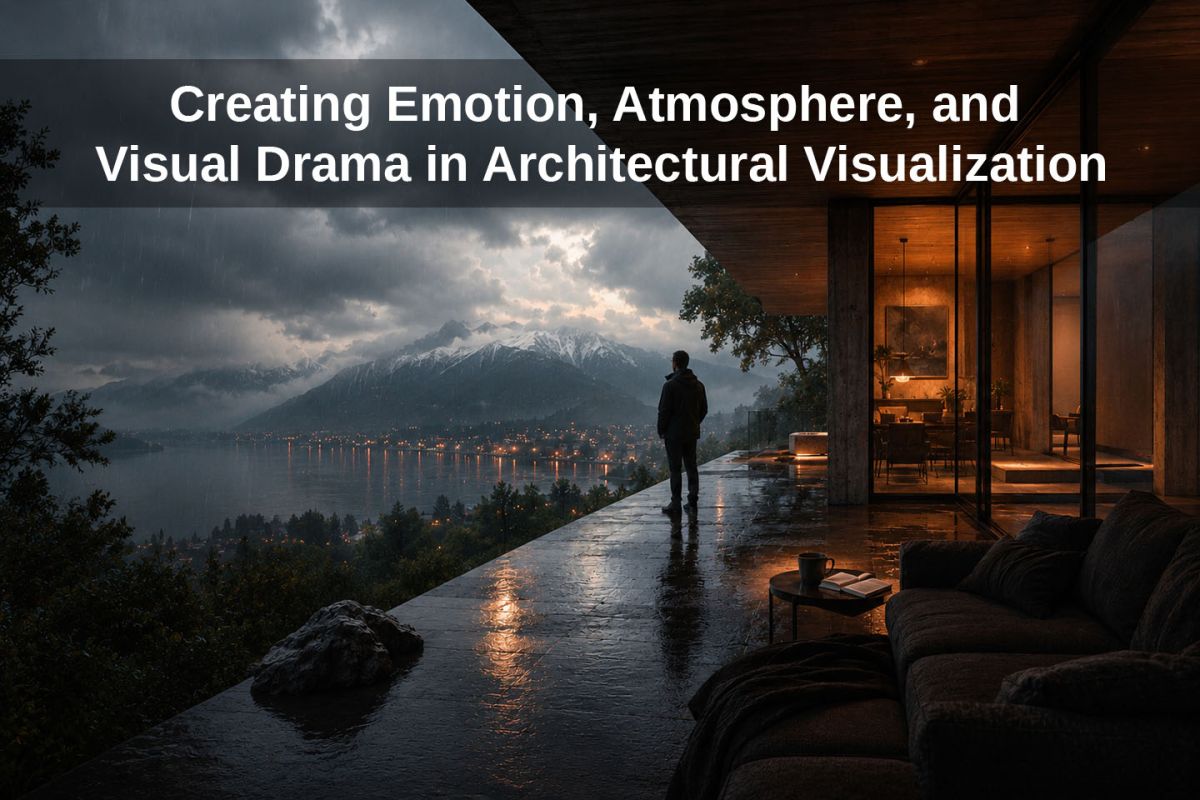
CAHDD Transparency — How The Header Image Was Created
Most of our work is CAHDD Stage 0 or Stage 1. That means it is either fully human-created or built using standard digital tools with complete human control. That is still the foundation of how we work.
For article header images, we push into CAHDD Stage 3 or 4. These images are either AI alterations to our work or AI created and refined by us, this does not represent our normal workflow. Because of that, we are calling it what it is.
This is not a replacement for how we work. It is a controlled use of a tool. We are testing it, understanding it, and being upfront about it.
CAHDD (Computer Aided Human Designed & Developed) is a framework we created to make this kind of transparency simple and visible. It is not about enforcement or gatekeeping. It is about showing where the human hand is and where the machine starts to get involved.
CAHDD Stages as they apply to architectural visualization:
Stage 0 — Fully hand-created work with no digital tools.
Stage 1 — Standard digital workflow. Modeling, rendering, and post-production with full human control.
Stage 2 — Procedural or automated processes that assist, but do not influence creative decisions.
Stage 3 — Human-directed work with AI assisting in refinement such as lighting, resolution, or visual polish.
Stage 4 — AI-generated content with human direction and selection.
Stage 5 — Fully AI-generated work with minimal human input.
Stage X — Mixed or evolving workflows that combine multiple stages.
Full framework and philosophy: CAHDD.org