Architecture First, Storytelling Second: Finding the Right Balance in Architectural Visualization
Architecture First, Storytelling Second
One of the concerns people sometimes have when they hear terms like Cinematic ArchViz™ or visual storytelling is that every rendering will suddenly become a movie poster.
That is not what we are advocating.
In fact, the opposite is true.
At 3DAStudio™, we believe the architecture should always remain the primary subject...
The Architecture Must Remain the Hero
Architects spend months or years refining a design. Developers invest significant time, money, and effort bringing a project to life. Interior designers carefully craft spaces around human needs and experiences.
The visualization should showcase that work...
The 80/20 Principle of Architectural Storytelling
In many projects, an informal 80/20 principle applies.
Approximately eighty percent of the imagery should focus on communicating architecture, planning, materials, interiors, context, and key project features.
The remaining twenty percent can be used to create emotional connection and memorability...
A Typical Five-Image Project Presentation
A balanced architectural visualization package often includes:
• An aerial or elevated view showing context and site relationships.
• A primary exterior hero image showcasing the architecture.
• A primary interior hero image highlighting important spaces.
• A feature image focusing on a unique architectural element or design detail.
• One storytelling image designed to create emotional engagement.
This approach provides a balanced presentation.
The majority of the imagery communicates information.
A select few images communicate experience.
Together they create a more complete understanding of the project.
Subtle Storytelling Is Often the Most Effective
When people hear the phrase "storytelling image," they sometimes imagine elaborate scenes with crowds of people, dramatic action, or highly theatrical compositions.
The reality is often much simpler.
Some of the strongest storytelling images are remarkably subtle...
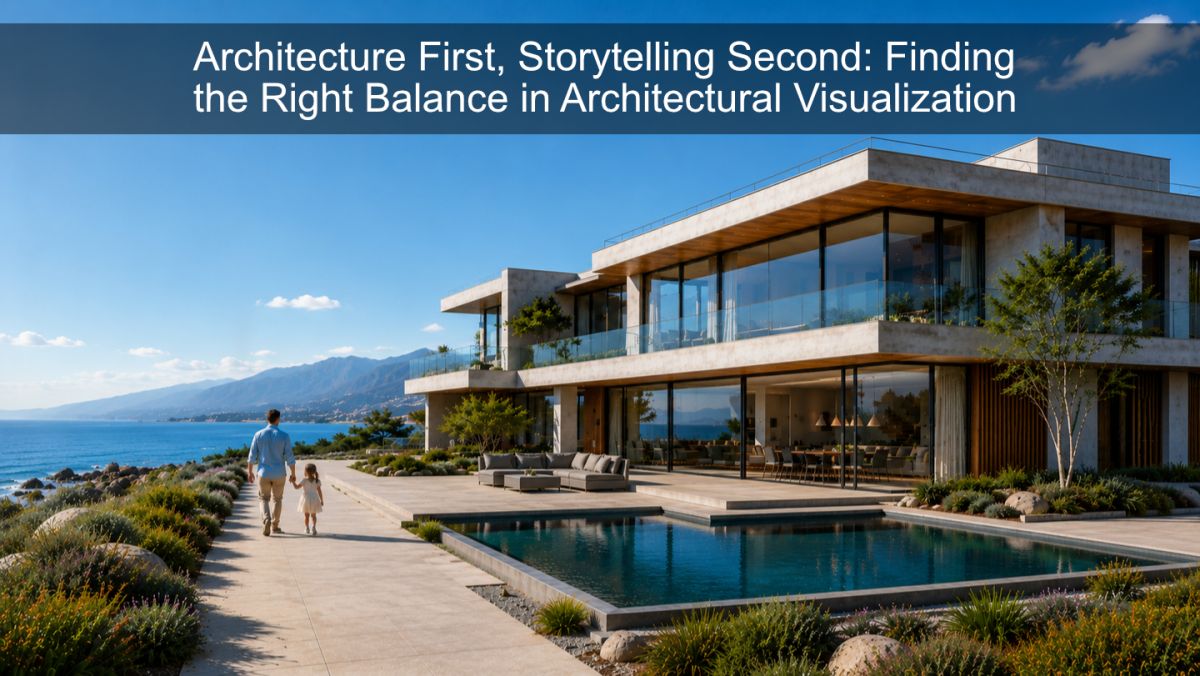
The Father and Daughter Example
Consider a modern waterfront home.
A rendering showing a father and daughter walking hand in hand toward the ocean does not distract from the architecture.
It reinforces it.
The image quietly communicates ideas that may be difficult to express through architecture alone:
• Family
• Connection
• Lifestyle
• Memory
• Experience
The architecture remains the focus.
The story simply provides context.
Rather than overwhelming the design, it helps viewers imagine themselves within it.
Different Images Have Different Jobs
One of the mistakes often made in visualization is expecting every image to accomplish everything at once.
In reality, different images serve different purposes.
Some images establish context.
Some images explain planning and circulation.
Some images showcase materials and detailing.
Some images demonstrate scale.
Some images create excitement.
Some images create emotional connection.
Trying to make every rendering cinematic can be just as problematic as making every rendering purely technical.
The strongest presentations recognize that different images have different jobs to perform.
Why Memorability Matters
Developers compete for investors.
Architects compete for commissions.
Projects compete for approvals.
Marketing teams compete for attention.
In these situations, memorability matters.
People may review dozens of proposals, presentations, and marketing materials.
A memorable image helps a project stand apart.
This does not require exaggerated drama.
It simply requires creating an image that resonates emotionally while remaining faithful to the design.
The Best Storytelling Often Goes Unnoticed
The most effective storytelling in architectural visualization is often invisible.
Viewers may never consciously recognize why they feel connected to an image.
They simply do.
A subtle gesture.
A familiar activity.
A sense of anticipation.
A feeling of arrival.
A suggestion of life beyond the frame.
These small elements can transform an image from documentation into communication.
Architecture First. Storytelling Second.
At 3DAStudio™, Cinematic ArchViz™ is not about turning every rendering into a cinematic masterpiece.
It is about understanding when storytelling can enhance communication and when it should step aside.
The architecture always comes first.
The design always comes first.
Storytelling exists to support those goals.
When applied thoughtfully and in moderation, it can help transform a project from something people see into something they remember.
Related Articles in This Series
Architectural visualization is more than creating realistic images. It is about shaping perception, guiding emotion, and telling stories through the built environment. Explore the complete Cinematic ArchViz™ article series:
- What Makes an Architectural Image Feel Cinematic?
- Telling a Story Through Design
- Environmental Storytelling Through Imperfection
- Cinematic ArchViz™ as Sequential Art
- Atmospheric Realism
- Lighting as Emotional Architecture
- Lens Language in Architectural Visualization
- Architecture First, Storytelling Second
Together, these articles explore the principles behind Cinematic ArchViz™—an approach to architectural visualization that emphasizes storytelling, atmosphere, emotion, composition, and the human experience of architecture.
CAHDD Transparency — How The Header Image Was Created
Most of our work is CAHDD Stage 0 or Stage 1. That means it is either fully human-created or built using standard digital tools with complete human control. That is still the foundation of how we work.
For article header images, we push into CAHDD Stage 3 or 4. These images are either AI alterations to our work or AI created and refined by us, this does not represent our normal workflow. Because of that, we are calling it what it is.
This is not a replacement for how we work. It is a controlled use of a tool. We are testing it, understanding it, and being upfront about it.
CAHDD (Computer Aided Human Designed & Developed) is a framework we created to make this kind of transparency simple and visible. It is not about enforcement or gatekeeping. It is about showing where the human hand is and where the machine starts to get involved.
CAHDD Stages as they apply to architectural visualization:
Stage 0 — Fully hand-created work with no digital tools.
Stage 1 — Standard digital workflow. Modeling, rendering, and post-production with full human control.
Stage 2 — Procedural or automated processes that assist, but do not influence creative decisions.
Stage 3 — Human-directed work with AI assisting in refinement such as lighting, resolution, or visual polish.
Stage 4 — AI-generated content with human direction and selection.
Stage 5 — Fully AI-generated work with minimal human input.
Stage X — Mixed or evolving workflows that combine multiple stages.
Full framework and philosophy: CAHDD.org