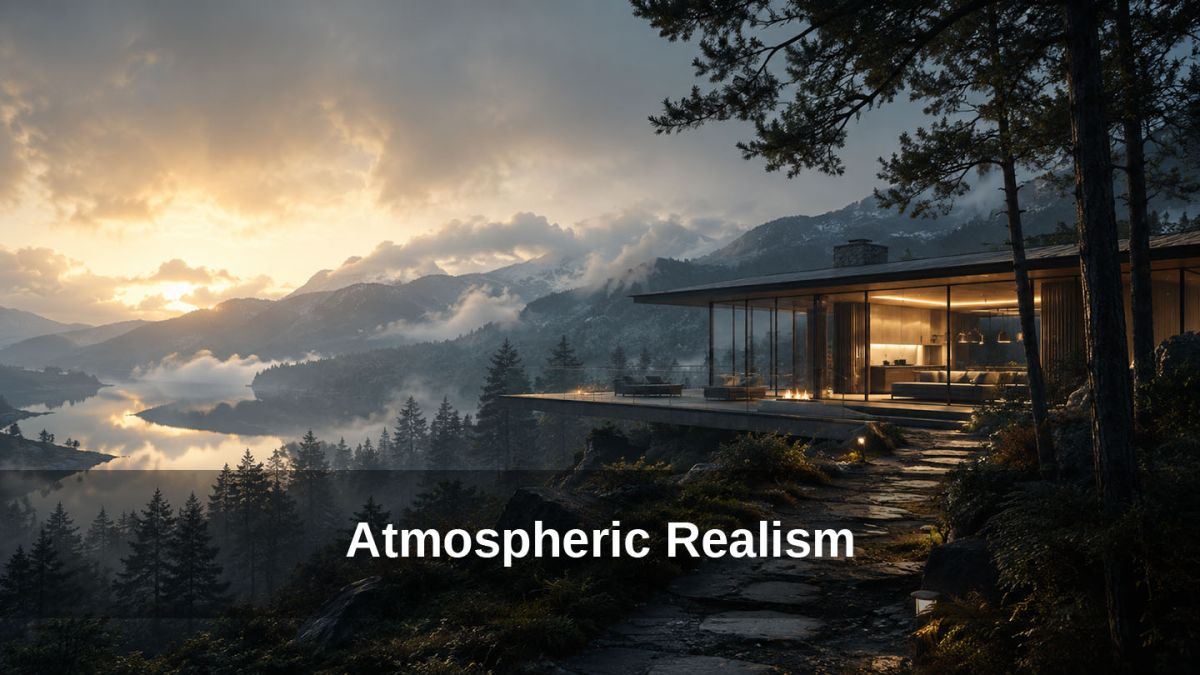
Atmospheric Realism
Why Realistic Architectural Imagery Often Depends on Imperfect Air, Light, and Environment
At 3DAStudio™, one of the core principles behind what we call Cinematic ArchViz™ is the belief that realism is not created solely through sharper textures, higher polygon counts, or more rendering power. Some of the most believable and emotionally compelling architectural imagery relies on something far less obvious:
Atmosphere.
Real environments contain air.
Humidity.
Dust.
Light diffusion.
Weather.
Haze.
Reflected moisture.
Environmental softness.
Distance falloff.
Subtle imperfection.
These elements dramatically affect how people emotionally perceive space, even when they are barely noticeable.
One of the biggest reasons many architectural renderings feel artificial is because the atmosphere itself feels absent. The environment becomes too clinically clear, too sharp, too evenly visible, and too disconnected from the natural behavior of light in the real world.
Atmospheric realism is one of the key elements that helps transform architectural visualization from technical imagery into emotionally immersive experience.
This philosophy is deeply connected to Cinematic ArchViz™, where the goal is not merely to show architecture clearly, but to make the environment feel believable, emotional, and alive.
Real Life Rarely Looks Perfectly Clear
One of the most common characteristics of non-cinematic rendering is excessive clarity.
Perfectly sharp distant objects.
Uniform contrast throughout the image.
No atmospheric falloff.
No environmental softness.
No diffusion.
In reality, human vision rarely perceives environments this way.
Real-world environments are constantly affected by:
- humidity
- dust
- pollution
- airborne moisture
- reflected light
- atmospheric scattering
- cloud cover
- environmental haze
- seasonal variation
Even on relatively clear days, distant objects soften subtly through atmospheric perspective.
These small effects are incredibly important psychologically because they help the brain perceive depth, scale, and realism.
Without atmosphere, environments often feel synthetic.
Atmospheric Perspective Creates Depth
Painters understood atmospheric perspective centuries before digital rendering existed.
Artists such as:
- J. M. W. Turner
- Claude Monet
- Caspar David Friedrich
- Leonardo da Vinci
all used atmosphere to create:
- scale
- emotional mood
- environmental realism
- visual layering
- spatial depth
Atmospheric perspective occurs naturally when distant objects lose:
- contrast
- saturation
- sharpness
- tonal separation
This creates layered depth perception.
Many architectural renderings fail because every object in the image appears equally sharp and equally visible regardless of distance.
Real environments rarely behave that way.
Softness Often Feels More Real Than Sharpness
One of the major misconceptions in visualization is that realism equals maximum sharpness.
In reality, excessive sharpness often creates a “CG” appearance.
Real environments contain:
- lens softness
- atmospheric diffusion
- subtle visual noise
- reflected moisture
- environmental scatter
- imperfect focus behavior
Cinema rarely relies on hyper-sharp imagery across the entire frame.
Instead, cinematic imagery often embraces:
- controlled softness
- atmospheric diffusion
- restrained clarity
- tonal blending
- subtle depth separation
This creates emotional realism.
Sometimes slightly reducing sharpness can make an image feel substantially more believable.
Weather Adds Emotional Complexity
Weather is one of the most powerful tools for atmospheric realism because it naturally introduces variation and environmental behavior.
Rain creates:
- reflections
- softened contrast
- environmental saturation
- light diffusion
- atmospheric layering
Fog creates:
- mystery
- distance falloff
- environmental softness
- visual depth
Snow creates:
- silence
- tonal simplicity
- environmental stillness
- softened acoustical feeling
Humidity creates:
- glow
- softened sunlight
- atmospheric warmth
Cloud cover creates:
- diffuse lighting
- restrained contrast
- emotional realism
Perfect weather often feels emotionally flat because it removes environmental complexity.
This is one reason overcast skies frequently feel more believable and cinematic than bright blue postcard conditions.
Overcast Lighting Often Feels More Authentic
Architectural visualization has historically leaned heavily toward bright sunny conditions because they present architecture clearly.
However, perfectly sunny conditions are not always emotionally convincing.
Overcast lighting often creates:
- softer transitions
- realistic shadow behavior
- restrained highlights
- environmental calmness
- atmospheric subtlety
- visual softness
This is particularly true in northern climates and coastal regions where atmospheric conditions are naturally diffused much of the year.
The Pacific Northwest, Scandinavia, Northern Europe, Japan, and coastal climates often contain atmospheric lighting conditions that feel emotionally rich precisely because they are imperfect.
Atmospheric Realism Reduces the “CG Look”
One reason atmospheric realism matters so much is because it directly reduces common CGI characteristics.
Overly digital-looking imagery often contains:
- perfectly sharp edges
- excessive clarity
- uniform visibility
- harsh contrast
- unrealistically clean lighting
- hyper-saturated color
- mathematically perfect reflections
Atmosphere naturally softens these qualities.
It introduces:
- visual blending
- environmental softness
- subtle randomness
- tonal variation
- realistic diffusion
The result often feels more photographic and emotionally believable.
Light Behaves Through Atmosphere
Light is heavily influenced by the environment it moves through.
In reality:
- humid air scatters light
- fog diffuses highlights
- dust softens sunlight
- moisture affects reflections
- haze alters color temperature
- clouds soften directional intensity
Many renderings fail because lighting behaves as though the air itself does not exist.
The image may contain physically accurate sunlight calculations while still feeling emotionally artificial because atmospheric interaction is missing.
Real light is rarely perfectly clean.
Atmosphere Helps Scale Feel Larger
Atmosphere is critical for communicating architectural scale.
Large environments without atmospheric depth often feel miniature or artificial.
This is especially important in:
- urban environments
- mountain settings
- waterfront projects
- large campuses
- skyline imagery
- aerial perspectives
Atmospheric layering helps viewers emotionally understand distance and environmental magnitude.
Without it, scale perception weakens.
Reflections Become More Believable Through Atmosphere
One major rendering problem involves reflections that feel too perfect.
Real reflections are affected by:
- moisture
- particulate matter
- environmental lighting
- surface contamination
- atmospheric softness
- imperfect surface behavior
Slight atmospheric diffusion often makes reflections feel dramatically more believable.
Especially:
- wet pavement
- water surfaces
- glass facades
- polished stone
- metallic materials
Perfect reflections often feel synthetic because real environments are visually more chaotic.
Atmosphere Creates Emotional Tone
Atmosphere is not merely technical realism.
It also shapes emotion.
Different atmospheric conditions communicate entirely different emotional experiences.
Heavy fog may feel:
- contemplative
- mysterious
- isolated
Warm haze may feel:
- nostalgic
- calm
- inviting
Rain may feel:
- intimate
- melancholic
- cinematic
Snow may feel:
- silent
- reflective
- peaceful
Atmospheric realism becomes emotional storytelling.
This is one reason cinema relies so heavily on atmospheric conditions to shape audience perception.
Architectural visualization can benefit from the same philosophy.
Environmental Softness Feels Human
One reason atmospheric realism often feels emotionally stronger is because it more closely resembles human visual perception.
Human vision is not mechanically sharp everywhere simultaneously.
Real perception contains:
- focal prioritization
- environmental softness
- adaptation to light
- peripheral reduction
- atmospheric blending
Images that embrace subtle softness often feel more natural because they mimic human observation rather than machine precision.
Atmospheric Restraint Is Important
One common mistake is overusing atmospheric effects.
Too much fog, bloom, haze, or diffusion can quickly become artificial.
Strong atmospheric realism is usually subtle.
The viewer should feel the atmosphere rather than immediately noticing the effect itself.
Controlled restraint is critical.
Scandinavian and Northern Influences
Many contemporary architectural visualizations that feel emotionally sophisticated share qualities commonly associated with northern climates and Scandinavian visual culture.
These often include:
- diffused daylight
- restrained contrast
- muted palettes
- environmental softness
- foggy depth
- calm tonal transitions
- subdued atmosphere
- quiet realism
These qualities frequently feel more cinematic because they resemble natural environmental perception rather than exaggerated visual spectacle.
Atmosphere and Cinematic ArchViz™
At 3DAStudio™, we believe atmospheric realism is one of the most important elements separating emotionally immersive architectural imagery from purely technical rendering.
This philosophy is deeply connected to Cinematic ArchViz™.
The goal is not simply to create sharper or more detailed images. The goal is to create environments that feel believable, emotional, and connected to real human experience.
Through atmospheric depth, environmental softness, weather interaction, restrained lighting, tonal variation, and subtle imperfection, architectural visualization begins feeling less synthetic and more alive.
Real environments contain atmosphere.
The most believable architectural imagery often should too.
Related Articles in This Series
Architectural visualization is more than creating realistic images. It is about shaping perception, guiding emotion, and telling stories through the built environment. Explore the complete Cinematic ArchViz™ article series:
- What Makes an Architectural Image Feel Cinematic?
- Telling a Story Through Design
- Environmental Storytelling Through Imperfection
- Cinematic ArchViz™ as Sequential Art
- Atmospheric Realism
- Lighting as Emotional Architecture
- Lens Language in Architectural Visualization
- Architecture First, Storytelling Second
Together, these articles explore the principles behind Cinematic ArchViz™—an approach to architectural visualization that emphasizes storytelling, atmosphere, emotion, composition, and the human experience of architecture.
CAHDD Transparency — How The Header Image Was Created
Most of our work is CAHDD Stage 0 or Stage 1. That means it is either fully human-created or built using standard digital tools with complete human control. That is still the foundation of how we work.
For article header images, we push into CAHDD Stage 3 or 4. These images are either AI alterations to our work or AI created and refined by us, this does not represent our normal workflow. Because of that, we are calling it what it is.
This is not a replacement for how we work. It is a controlled use of a tool. We are testing it, understanding it, and being upfront about it.
CAHDD (Computer Aided Human Designed & Developed) is a framework we created to make this kind of transparency simple and visible. It is not about enforcement or gatekeeping. It is about showing where the human hand is and where the machine starts to get involved.
CAHDD Stages as they apply to architectural visualization:
Stage 0 — Fully hand-created work with no digital tools.
Stage 1 — Standard digital workflow. Modeling, rendering, and post-production with full human control.
Stage 2 — Procedural or automated processes that assist, but do not influence creative decisions.
Stage 3 — Human-directed work with AI assisting in refinement such as lighting, resolution, or visual polish.
Stage 4 — AI-generated content with human direction and selection.
Stage 5 — Fully AI-generated work with minimal human input.
Stage X — Mixed or evolving workflows that combine multiple stages.
Full framework and philosophy: CAHDD.org