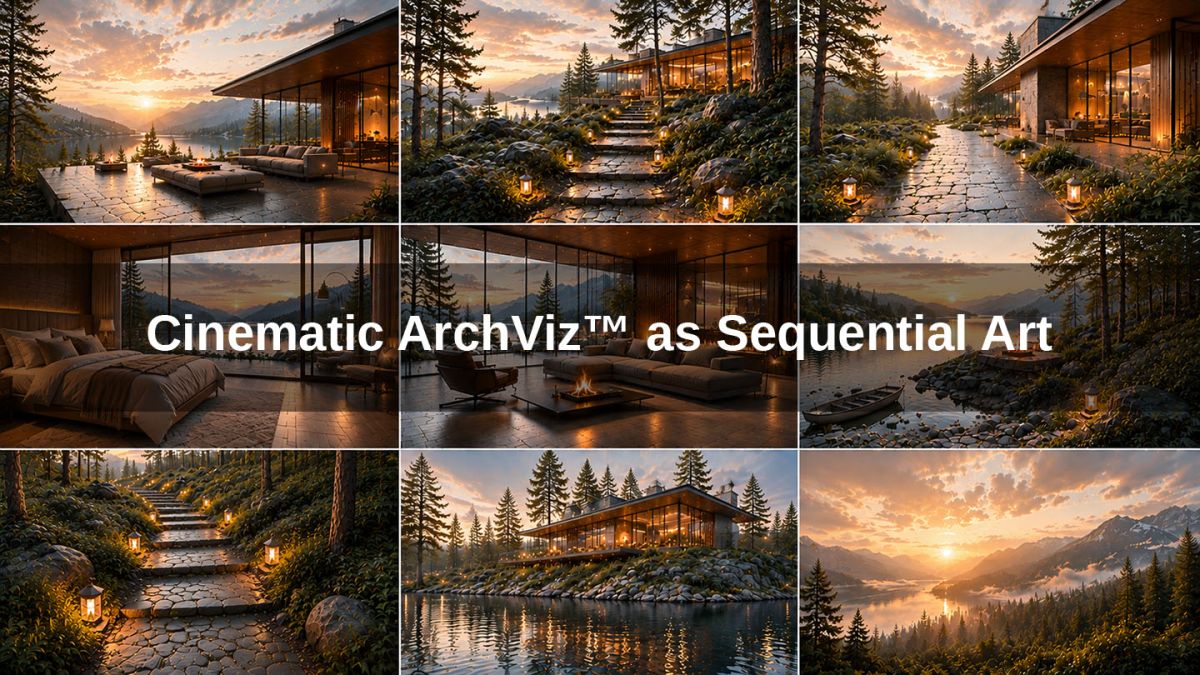
Cinematic ArchViz™ as Sequential Art
Architecture as Journey, Procession, and Controlled Experience
At 3DAStudio™, one of the foundational ideas behind what we call Cinematic ArchViz™ is the belief that architecture is rarely experienced as a single static image. Real architecture unfolds gradually through movement, discovery, framing, compression, release, atmosphere, and emotional progression.
People move through architecture.
They approach it.
Enter it.
Transition through it.
Discover views.
Encounter changing light.
Experience moments of tension and release.
Feel spaces open and compress around them.
This creates narrative.
Some of the most powerful architectural experiences in history were carefully choreographed long before cinema ever existed. Greek temples, Roman forums, Gothic cathedrals, Japanese gardens, and many of the world’s most memorable cities were designed around controlled movement and sequential emotional experience.
Architecture has always contained cinematic qualities.
Cinematic ArchViz™ simply attempts to recognize and reinforce them visually.
A cinematic architectural image often feels compelling because it suggests a larger spatial journey beyond the single frame. The viewer senses there is more to discover outside the boundaries of the image.
The rendering becomes less like a static illustration and more like a moment taken from an unfolding visual narrative.
Architecture Was Historically Designed as Procession
Historically, many important architectural traditions were deeply concerned with how people emotionally experienced movement through space.
Greek architecture often used controlled approach routes and carefully framed perspectives to create visual impact gradually rather than instantly.
Roman planning emphasized procession, axis alignment, monument reveal, and choreographed spatial sequence.
Gothic cathedrals used compression, verticality, shadow, and light to create emotional transition from exterior to interior.
Japanese gardens frequently concealed views intentionally, allowing environments to reveal themselves slowly over time through movement and framed perspective.
Frank Lloyd Wright often designed compression and release into circulation pathways, using lower ceilings and tighter spaces before opening dramatically into larger volumes.
These environments were not designed merely as objects to observe.
They were designed as experiences unfolding through time.
This is an important distinction.
Architecture is inherently sequential.
Most Architectural Renderings Ignore Sequential Experience
One of the major weaknesses in many architectural visualizations is that they present buildings as isolated objects rather than lived spatial experiences.
The rendering becomes:
- a product shot
- a diagram
- a technical presentation
- a static overview
The emotional journey disappears.
Many images attempt to show everything at once:
- full visibility
- full clarity
- complete understanding
- perfectly centered composition
Ironically, this often weakens emotional engagement.
Real environments rarely reveal themselves all at once.
Cinematic imagery often becomes more powerful when portions of the environment remain implied rather than fully exposed.
Mystery creates engagement.
Cinematic Imagery Often Suggests Movement Beyond the Frame
One of the defining characteristics of cinematic imagery is the feeling that the scene exists beyond the single image.
The frame feels connected to:
- a larger environment
- prior movement
- future movement
- unseen spaces
- implied narrative progression
The viewer subconsciously imagines:
- where the path continues
- what exists around the corner
- what lies beyond the visible space
- how the environment unfolds spatially
This creates immersion.
A rendering stops feeling like a static object and starts feeling like part of a larger experience.
Controlled Reveal Is a Powerful Tool
One of the most important concepts in sequential environmental storytelling is controlled reveal.
Not everything should be visible immediately.
Architecture often becomes emotionally stronger when views unfold gradually.
Examples include:
- partially obscured entrances
- framed distant views
- layered foregrounds
- spaces revealed through thresholds
- directional lighting
- pathways curving out of sight
- transitional compression before openness
- architectural silhouettes emerging through atmosphere
Cinema uses the same principle constantly.
The viewer becomes emotionally engaged because discovery is occurring over time.
Foreground Framing Creates Spatial Depth
Many cinematic architectural images use foreground elements to create a sense of layered spatial progression.
Foreground framing can include:
- vegetation
- structural elements
- shadows
- silhouettes
- partially visible objects
- architectural overhangs
- reflections
- environmental obstructions
This creates the feeling that the viewer is physically positioned within the environment rather than observing it externally.
The image begins to feel inhabited and experiential.
Compression and Release Create Emotional Rhythm
One of the oldest spatial storytelling techniques in architecture involves compression and release.
This occurs when movement transitions between:
- narrow and wide spaces
- dark and bright spaces
- low and tall spaces
- enclosed and open environments
These transitions create emotional rhythm.
Without rhythm, environments often feel visually flat.
Cinematic architectural imagery can reinforce this idea compositionally by:
- emphasizing threshold moments
- using directional framing
- controlling visibility
- manipulating environmental openness
- layering atmosphere
- introducing gradual reveal
The image begins communicating emotional movement rather than static information.
Partial Visibility Often Feels More Cinematic
Many weaker renderings attempt to show every detail simultaneously.
Cinematic imagery frequently does the opposite.
Selective visibility creates:
- mystery
- focus
- emotional depth
- visual hierarchy
- narrative tension
Examples include:
- shadows obscuring portions of space
- fog softening distant elements
- partially hidden interiors
- silhouettes rather than fully visible figures
- architecture emerging gradually from landscape
- layered environmental depth
The viewer becomes more engaged because the image invites participation rather than simply delivering information.
Architectural Journey Matters More Than Single Moments
Many architects design spaces around movement and emotional progression rather than isolated viewpoints.
The same philosophy can strengthen architectural visualization.
Questions worth asking include:
- How would someone approach this space?
- What would they notice first?
- What becomes visible later?
- How does the environment unfold emotionally?
- Where does tension exist?
- Where does relief occur?
- How does light evolve through movement?
- How does scale perception change over time?
These ideas move visualization closer to experiential storytelling.
Camera Placement Changes Emotional Experience
Cinematic architectural imagery often feels stronger because the camera behaves more like a human observer than a technical diagram.
Many non-cinematic renderings rely on:
- elevated perspectives
- excessively wide lenses
- impossible viewpoints
- detached observation
Cinematic imagery often uses:
- human eye-level perspectives
- restrained focal lengths
- spatial immersion
- directional movement
- emotionally grounded composition
The viewer feels present within the environment rather than disconnected from it.
Environmental Layering Suggests Spatial Continuity
Layering is critical to sequential visual storytelling.
Strong cinematic imagery often contains:
- foreground elements
- midground activity
- atmospheric background depth
- implied continuation beyond visible boundaries
This layering creates:
- scale
- immersion
- environmental continuity
- spatial realism
Flat imagery often feels emotionally weaker because all visual information exists on a single plane.
Real environments unfold through depth.
Light Can Guide Sequential Experience
Lighting is one of the strongest tools for directing movement and emotional focus.
Architectural visualization can use lighting to:
- guide the eye
- suggest progression
- frame destinations
- emphasize thresholds
- create emotional pacing
- reveal and conceal information
This is common in cinema.
The viewer naturally follows light through the composition.
Architecture itself often does the same thing.
Sequential Storytelling Exists in Great Cities
Some of the most memorable urban environments in the world rely heavily on sequential experience.
Examples include:
- narrow European streets opening into public plazas
- layered alley systems in Tokyo
- ceremonial approaches in Rome
- compressed urban corridors revealing skyline views
- mountain roads gradually exposing landscapes
- waterfront pathways revealing architecture incrementally
The emotional power comes from progression and reveal rather than instant visibility.
This same principle can strengthen architectural visualization dramatically.
Atmosphere Enhances Sequential Experience
Atmosphere naturally supports cinematic spatial progression because it softens visibility and enhances environmental depth.
Fog, haze, rain, smoke, and shadow:
- obscure distant information
- layer environments
- create gradual reveal
- increase mystery
- strengthen emotional pacing
Perfect clarity often weakens sequential storytelling because everything becomes immediately visible.
Atmosphere allows environments to unfold more naturally.
Sequential Art and Cinematic ArchViz™
At 3DAStudio™, we believe architectural visualization becomes more emotionally compelling when it reflects how architecture is actually experienced through movement, discovery, progression, and environmental immersion.
This idea is one of the core principles behind Cinematic ArchViz™.
Architecture is not merely an object.
It is an unfolding experience shaped by atmosphere, light, sequence, perspective, framing, and emotional rhythm.
Through controlled reveal, environmental layering, atmospheric depth, foreground framing, spatial progression, and cinematic composition, architectural imagery can begin feeling less like static documentation and more like a moment within a larger journey.
That emotional continuity is often what separates a technically good rendering from one people genuinely remember.
The image stops feeling isolated.
It starts feeling connected to a living environment beyond the frame.
Related Articles in This Series
Architectural visualization is more than creating realistic images. It is about shaping perception, guiding emotion, and telling stories through the built environment. Explore the complete Cinematic ArchViz™ article series:
- What Makes an Architectural Image Feel Cinematic?
- Telling a Story Through Design
- Environmental Storytelling Through Imperfection
- Cinematic ArchViz™ as Sequential Art
- Atmospheric Realism
- Lighting as Emotional Architecture
- Lens Language in Architectural Visualization
- Architecture First, Storytelling Second
Together, these articles explore the principles behind Cinematic ArchViz™—an approach to architectural visualization that emphasizes storytelling, atmosphere, emotion, composition, and the human experience of architecture.
CAHDD Transparency — How The Header Image Was Created
Most of our work is CAHDD Stage 0 or Stage 1. That means it is either fully human-created or built using standard digital tools with complete human control. That is still the foundation of how we work.
For article header images, we push into CAHDD Stage 3 or 4. These images are either AI alterations to our work or AI created and refined by us, this does not represent our normal workflow. Because of that, we are calling it what it is.
This is not a replacement for how we work. It is a controlled use of a tool. We are testing it, understanding it, and being upfront about it.
CAHDD (Computer Aided Human Designed & Developed) is a framework we created to make this kind of transparency simple and visible. It is not about enforcement or gatekeeping. It is about showing where the human hand is and where the machine starts to get involved.
CAHDD Stages as they apply to architectural visualization:
Stage 0 — Fully hand-created work with no digital tools.
Stage 1 — Standard digital workflow. Modeling, rendering, and post-production with full human control.
Stage 2 — Procedural or automated processes that assist, but do not influence creative decisions.
Stage 3 — Human-directed work with AI assisting in refinement such as lighting, resolution, or visual polish.
Stage 4 — AI-generated content with human direction and selection.
Stage 5 — Fully AI-generated work with minimal human input.
Stage X — Mixed or evolving workflows that combine multiple stages.
Full framework and philosophy: CAHDD.org