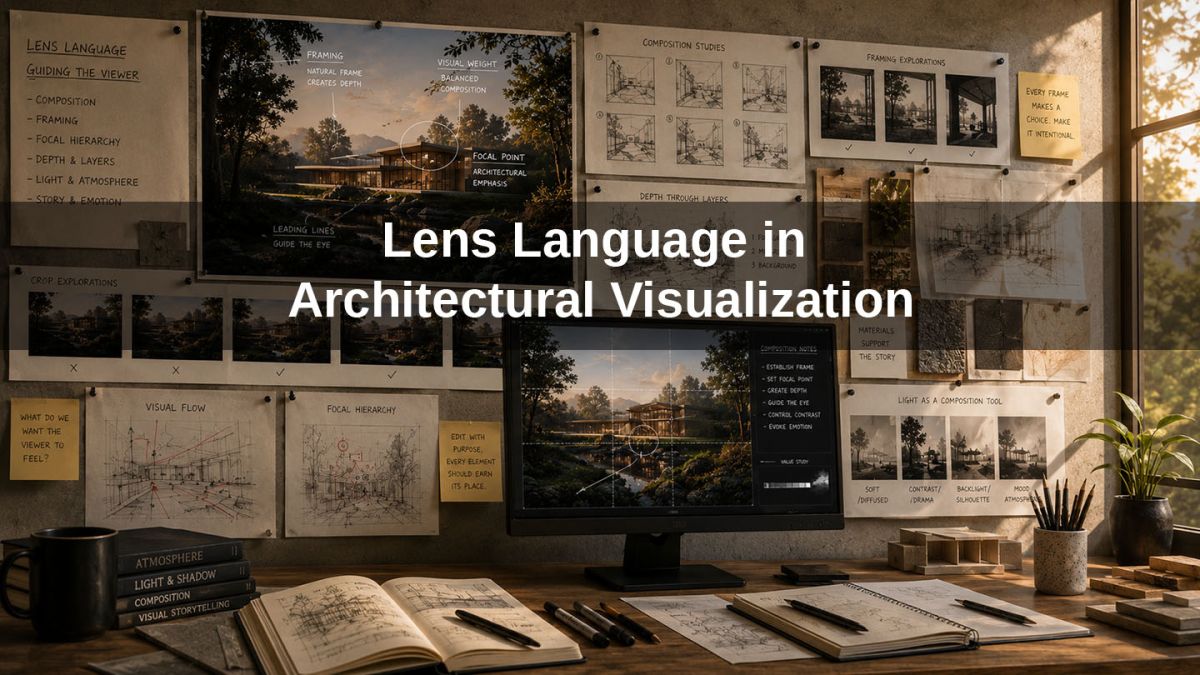
Lens Language in Architectural Visualization
Related Articles in This Series
Architectural visualization is more than creating realistic images. It is about shaping perception, guiding emotion, and telling stories through the built environment. Explore the complete Cinematic ArchViz™ article series:
- What Makes an Architectural Image Feel Cinematic?
- Telling a Story Through Design
- Environmental Storytelling Through Imperfection
- Cinematic ArchViz™ as Sequential Art
- Atmospheric Realism
- Lighting as Emotional Architecture
- Lens Language in Architectural Visualization
- Architecture First, Storytelling Second
Together, these articles explore the principles behind Cinematic ArchViz™—an approach to architectural visualization that emphasizes storytelling, atmosphere, emotion, composition, and the human experience of architecture.
CAHDD Transparency — How The Header Image Was Created
Most of our work is CAHDD Stage 0 or Stage 1. That means it is either fully human-created or built using standard digital tools with complete human control. That is still the foundation of how we work.
For article header images, we push into CAHDD Stage 3 or 4. These images are either AI alterations to our work or AI created and refined by us, this does not represent our normal workflow. Because of that, we are calling it what it is.
This is not a replacement for how we work. It is a controlled use of a tool. We are testing it, understanding it, and being upfront about it.
CAHDD (Computer Aided Human Designed & Developed) is a framework we created to make this kind of transparency simple and visible. It is not about enforcement or gatekeeping. It is about showing where the human hand is and where the machine starts to get involved.
CAHDD Stages as they apply to architectural visualization:
Stage 0 — Fully hand-created work with no digital tools.
Stage 1 — Standard digital workflow. Modeling, rendering, and post-production with full human control.
Stage 2 — Procedural or automated processes that assist, but do not influence creative decisions.
Stage 3 — Human-directed work with AI assisting in refinement such as lighting, resolution, or visual polish.
Stage 4 — AI-generated content with human direction and selection.
Stage 5 — Fully AI-generated work with minimal human input.
Stage X — Mixed or evolving workflows that combine multiple stages.
Full framework and philosophy: CAHDD.org